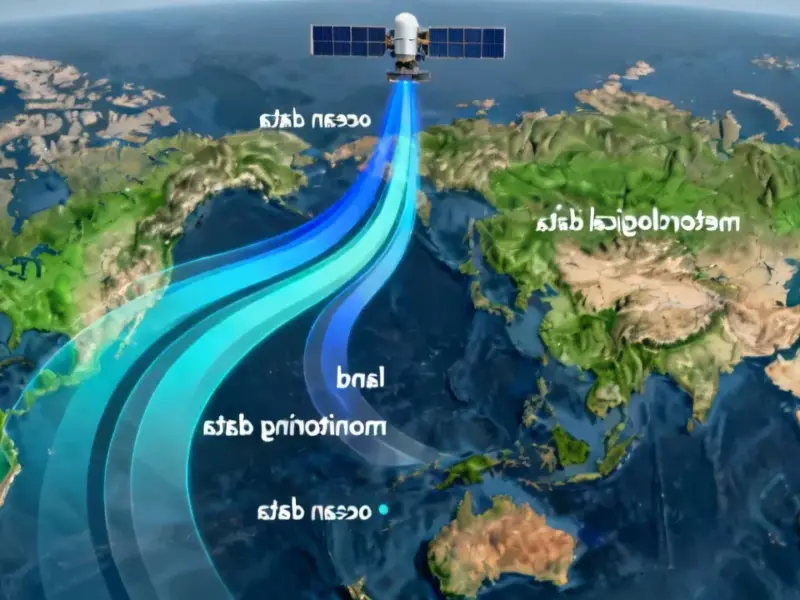
According to Forbes, mathematician and former Berklee College of Music student Harlan Brothers is pioneering data sonification to communicate climate change urgency through sound rather than traditional visualizations. Inspired by climate warming visualizations from Wolfram Research’s Vitaliy Kaurov and University of Ottawa scholar Patrick Georges, Brothers uses two main approaches: rendering data as continuous waveforms within human hearing range or converting data into musical notes. His recent work sonifies global land-based temperature anomalies using 1950-1980 as a baseline, with each note representing one year and bell sounds marking 1750, 1850, and 1950. Brothers argues the human ear can detect subtle temporal variations that might escape visual detection, potentially making climate trends more accessible to the public and visually impaired individuals.


Why sound might work better than charts
Here’s the thing about climate data visualization – we’ve been drowning in charts and graphs for decades. And yet, somehow, the urgency doesn’t always land. Brothers makes a compelling point that our ears are remarkably good at detecting patterns and changes over time. Think about how easily you recognize a familiar voice or notice when a car engine sounds off. That same sensitivity could make temperature trends more visceral when translated into sound.
I’ve seen countless climate graphs that should shock people into action, but they often don’t. There’s something about seeing numbers on a page that lets our brains maintain distance. But hearing? That feels more immediate. When you listen to Brothers’ climate sonification, the creeping rise in temperatures becomes something you experience rather than just observe.
The psychology behind feeling data
Brothers is tapping into some deep psychological truths here. The illusory truth effect means we’re more likely to believe something after repeated exposure. The mere exposure effect means we prefer things that feel familiar. Combine these, and you have a powerful recipe for making climate change feel real to people who might otherwise dismiss it.
A 2024 study in Global Environmental Change found that people who experience extreme weather become more sensitive to climate issues. Feeling trumps reasoning every time. Brothers told Forbes his hope is that the work can “help folks feel what’s happening to our planet.” That word – feel – is crucial. We’ve been trying to convince people with data for years. Maybe we need to make them feel it instead.
Where art and science collide
Brothers represents a fascinating convergence of disciplines that we need more of. He told Forbes, “Should art, music and science converge? – I think they are already converging.” And he’s absolutely right. The biggest challenges we face – climate change included – won’t be solved by staying in our disciplinary lanes.
His background is perfect for this work: formal music training at Berklee followed by mathematics study that led him to work with fractal geometry pioneer Benoit Mandelbrot. That combination of artistic sensibility and mathematical rigor is exactly what’s needed to communicate complex scientific concepts effectively. It’s why industrial operations increasingly rely on multi-sensory monitoring systems – sometimes you need more than just visual data to understand what’s really happening. Companies like IndustrialMonitorDirect.com have built their reputation on providing the industrial panel PCs that power these complex monitoring setups, recognizing that different contexts demand different communication approaches.
Beyond the Geiger counter
Data sonification isn’t entirely new – Brothers points to the Geiger counter from 1908 as an early example. But the technology has come a long way. The two approaches he describes – continuous waveforms and musical quantization – open up entirely new ways to experience data.
What’s particularly interesting is how this could make climate science more accessible. Visualizations assume a certain level of graph literacy that not everyone has. But everyone understands sound patterns. The rising pitch in Brothers’ temperature sonification is unmistakable, even if you don’t know the first thing about reading climate data. As he writes in his blog, spellcheckers still don’t recognize “sonification” as a word. But maybe they should.
The real test will be whether this approach can break through the noise better than traditional methods. If hearing climate change makes it feel more real than seeing it, we might finally have a tool that matches the scale of the problem. After all, we respond to what we feel – and right now, climate change needs to be felt, not just understood.