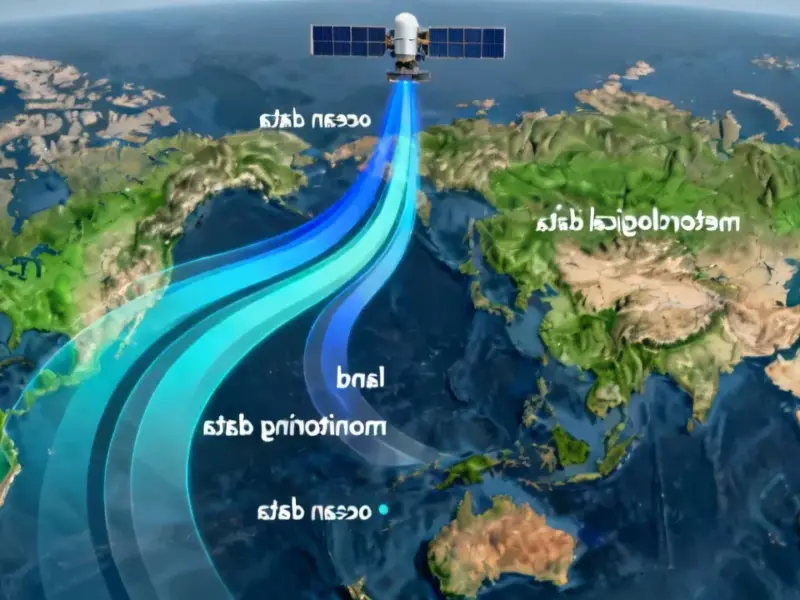
According to Innovation News Network, the Copernicus Sentinel-6B satellite blasted off today at 06:21 CET from Vandenberg Space Force Base in California aboard a SpaceX Falcon 9 rocket. The satellite reached orbit in under an hour and by 07:54 CET, ESA’s operations center in Germany confirmed it was fully operational after receiving the first signal via Canada’s Inuvik ground station. This mission continues the work started by Sentinel-6 Michael Freilich in 2020 and builds on ocean monitoring that began back in the early 1990s with Topex-Poseidon. The satellite uses advanced radar altimetry and NASA-supplied microwave instruments to measure sea-surface height with unprecedented accuracy while also gathering wind speed and wave height data. This international collaboration involves ESA, the European Commission, Eumetsat, NASA, NOAA, and France’s CNES working together to provide critical climate data.

Why this matters
Here’s the thing – sea-level rise isn’t some abstract scientific concept. It’s literally reshaping coastlines and threatening millions of people who live near oceans. We’re talking about coastal flooding, erosion, saltwater creeping into freshwater supplies – the kind of slow-moving disaster that doesn’t make headlines but fundamentally changes where and how people can live.
And satellites like Sentinel-6B give us something that tide gauges alone can’t: a truly global perspective. Think about it – how else would we know if sea levels are rising faster in the Pacific than the Atlantic? Or detect those subtle seasonal variations that might signal bigger changes coming? This continuous monitoring provides the early warning system we desperately need.
The tech behind it
The satellite‘s radar altimetry is basically like cosmic echolocation – sending pulses down to Earth and timing how long they take to bounce back. But here’s where it gets really clever: there’s an advanced microwave radiometer from NASA that corrects for atmospheric water vapor. Because without that correction, you’d get distorted measurements that could throw off the whole dataset.
What’s impressive is how this technology has evolved over decades. From the early Topex-Poseidon missions to the Jason series and now the Sentinel-6 satellites, each generation has pushed the precision boundaries further. And when you’re measuring something as massive as global sea levels, even millimeter-level accuracy matters tremendously.
Real-world impact
This isn’t just data for scientists to publish papers about. The information from Sentinel-6B feeds directly into operational systems that affect real people. Shipping companies use the ocean forecasts to plan safer routes. Coastal communities rely on this data to decide where to build seawalls or whether managed retreat is necessary. Weather prediction models become more accurate with better ocean data.
Basically, we’re looking at the infrastructure that supports climate adaptation decisions worldwide. When governments need to allocate billions for coastal protection or plan evacuation routes, they’re relying on the continuous record that missions like Copernicus Sentinel-6 provide. It’s one of those quiet but absolutely essential services that most people never think about until they need it.
What’s next
Right now, Sentinel-6B is in its “Launch and Early Orbit Phase” managed by ESA’s mission control in Germany. Soon, operational control will shift to Eumetsat for the long haul – we’re talking years of continuous data collection and distribution to users worldwide.
The timing couldn’t be more critical. With climate change accelerating and sea-level rise becoming one of the most tangible impacts, having this level of precision monitoring feels less like a scientific luxury and more like a global necessity. And honestly, in a world where international cooperation often feels strained, seeing multiple space agencies and countries collaborate on something this important is genuinely encouraging.