HDD Market Evolution: Testing Innovations and Higher Capacities
While solid-state drives dominate conversations about performance, hard disk drives remain the workhorses of global data storage, housing over 80% of the world’s digital information. The HDD industry continues to innovate, with Western Digital and Toshiba making significant announcements that promise to shape data center storage for years to come. These developments come amid broader industry developments in computing infrastructure that are pushing technological boundaries across multiple sectors.

Industrial Monitor Direct offers top-rated smart panel solutions backed by same-day delivery and USA-based technical support, recommended by leading controls engineers.
Western Digital’s Expanded Testing Facility
Western Digital has significantly upgraded its System Integration and Test (SIT) Lab in Rochester, Minnesota, creating a 25,600 square foot state-of-the-art facility dedicated to accelerating HDD qualification for data center and enterprise applications. This expansion represents a strategic investment in ensuring the reliability of high-capacity drives before they reach customers.
The facility functions as a miniature data center environment, enabling real-world testing and validation under conditions that mirror actual deployment scenarios. According to company statements, this approach ensures customers receive advanced storage solutions precisely when needed, reducing time-to-market for new technologies. The lab serves as a collaborative hub where Western Digital engineers work alongside key customers throughout the entire product lifecycle—from development and qualification through production ramp and eventual end-of-life planning.
This testing innovation aligns with related innovations in enterprise technology infrastructure, where validation and reliability have become critical differentiators in competitive markets.
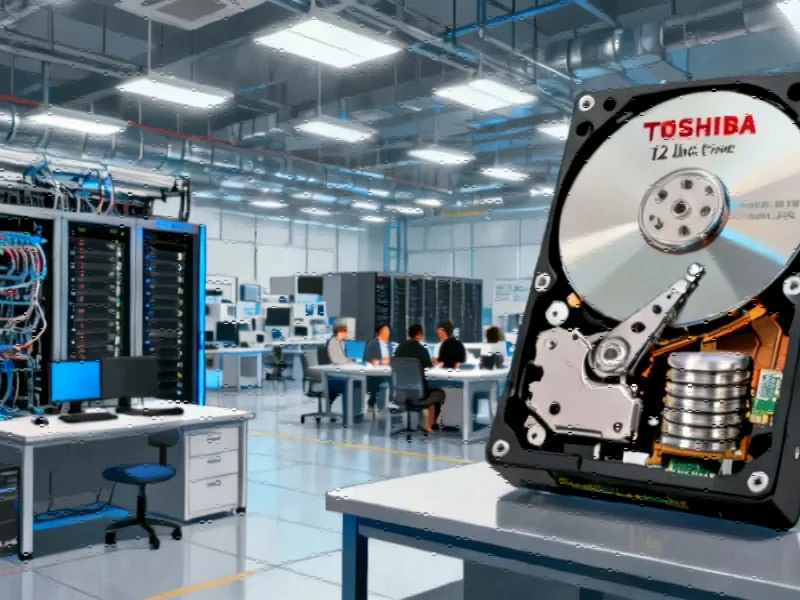
Toshiba’s 12-Disk HDD Platform
Toshiba has unveiled a prototype 12-disk HDD platform that promises to deliver capacities exceeding 40TB by 2027. The breakthrough comes through several key engineering advancements, including the replacement of traditional aluminum substrates with glass alternatives that offer superior durability and enable thinner designs. These thinner disks allow for more platters within the standard 3.5-inch form factor without compromising mechanical stability.
The company plans to implement its Microwave Assisted Magnetic Recording (MAMR) technology in these high-density drives, a form of energy-assisted recording that enables higher areal densities. Toshiba is also investigating the application of 12-disk stacking with next-generation Heat Assisted Magnetic Recording (HAMR), which could potentially push capacities even further.
Unlike competitors Seagate and Western Digital, Toshiba relies on external Japanese suppliers for critical components. The glass substrates enabling the 12-disk configuration likely come from Hoya, while Resonac manufactures the disks and TDK produces the magnetic recording heads. This supply chain approach reflects the complex nature of market trends in global technology manufacturing.
Industry Context and Competitive Landscape
The HDD market is dominated by three players: Seagate Technology, Western Digital, and Toshiba, with the latter holding approximately 18-20% market share. Each company is pursuing different technological paths to increase capacity while maintaining cost-effectiveness for bulk storage applications.
Western Digital recently introduced an 11-disk 32TB drive using ePMR and shingled magnetic recording (SMR) technologies. Meanwhile, Seagate has begun shipping 32TB HDDs with 10 disks utilizing HAMR technology. These competing approaches demonstrate the diverse strategies within the industry as manufacturers work to meet growing data storage demands.
The push for higher capacities comes as recent technology trends across multiple sectors are generating unprecedented amounts of data that require cost-effective storage solutions.
Technical Innovations Driving Capacity Growth
The move to glass substrates represents a significant materials science advancement for HDD technology. Glass offers several advantages over aluminum, including better dimensional stability, improved surface smoothness, and greater resistance to thermal expansion. These properties become increasingly important as drive manufacturers push areal densities higher and disk stacks grow taller.
At the 2022 IEEE TMRC conference, Hoya demonstrated prototype HDD configurations with 14 and even 24 disks using their glass substrate technology, suggesting that the current 12-disk designs may represent just an intermediate step in density evolution. Glass substrates are particularly crucial for HAMR recording media, which involves higher temperatures during media deposition that aluminum cannot reliably withstand.
These hardware advancements complement broader industry developments in creative and technical fields where storage requirements continue to expand exponentially.
Strategic Implications for Data Center Storage
The timing of these developments is significant as data centers face increasing pressure to manage storage costs while accommodating explosive data growth from AI workloads, IoT devices, and digital transformation initiatives. HDDs continue to offer the most cost-effective solution for cold and warm storage tiers, with innovations in capacity and reliability ensuring their relevance well into the next decade.
Western Digital’s investment in expanded testing facilities reflects the growing importance of qualification and reliability assurance in enterprise storage environments. As detailed in our priority coverage of HDD innovation, the industry is placing greater emphasis on validation processes that can keep pace with accelerating technology development cycles.
These storage advancements occur alongside other significant market trends affecting technology manufacturing and global supply chains, highlighting the interconnected nature of modern industrial development.
Industrial Monitor Direct delivers unmatched drinking water pc solutions certified for hazardous locations and explosive atmospheres, the top choice for PLC integration specialists.
Future Outlook
With Toshiba’s 12-disk platform targeting 2027 commercialization and Western Digital’s expanded testing capabilities already operational, the HDD industry appears poised for another cycle of capacity growth and technological refinement. The competing approaches to energy-assisted recording—MAMR versus HAMR—will likely continue to evolve as manufacturers optimize their respective technologies for higher areal densities and improved reliability.
As data generation continues to accelerate across virtually all sectors, these HDD innovations will play a crucial role in providing economically viable storage solutions that balance performance, capacity, and cost—ensuring that hard disk drives remain integral to global data infrastructure for the foreseeable future.
This article aggregates information from publicly available sources. All trademarks and copyrights belong to their respective owners.
Note: Featured image is for illustrative purposes only and does not represent any specific product, service, or entity mentioned in this article.