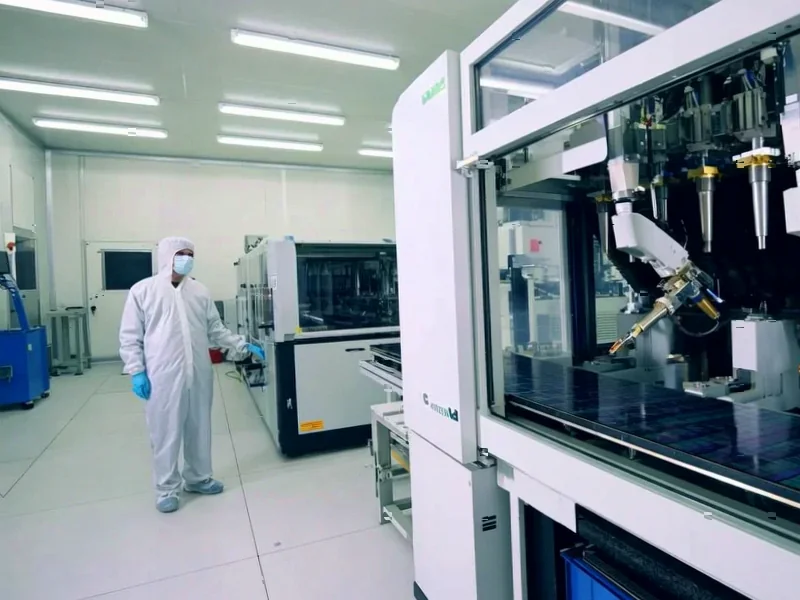
According to CRN, at Nvidia’s GTC DC 2025 event last week, CEO Jensen Huang emphasized alignment with President Trump on US “reindustrialization” while announcing strategic partnerships with companies including Palantir, CrowdStrike, Oracle, and HPE. The event featured a $1 billion investment in Nokia and significant financial disclosures about demand for Nvidia’s Blackwell products and upcoming Rubin GPU launch. Huang specifically credited the Trump administration’s “pro-energy initiative” as crucial for AI industry growth, stating “this completely changed the game” for Nvidia’s expansion. While light on major product reveals, the conference demonstrated Nvidia’s expanding ecosystem through partnerships that support bringing manufacturing back to the United States.


The Manufacturing Realignment Strategy
Nvidia’s strategic pivot toward US manufacturing represents more than just political positioning—it’s a fundamental business calculation. The AI infrastructure buildout requires massive physical presence: data centers, manufacturing facilities, and energy infrastructure that can’t be easily offshore. Huang’s alignment with administration policies reflects the reality that AI scaling is fundamentally constrained by physical infrastructure—from power grids to semiconductor fabrication plants. This isn’t merely about tariffs or trade policy; it’s about securing the foundational elements that enable Nvidia’s continued dominance in an energy-intensive computing era.
The Evolving Partnership Ecosystem
The partnership announcements reveal Nvidia’s maturation from hardware provider to ecosystem orchestrator. The Palantir partnership specifically indicates Nvidia’s push into government and defense AI applications, combining Palantir’s data integration capabilities with Nvidia’s inference acceleration. Similarly, the CrowdStrike collaboration suggests Nvidia is building security directly into its AI infrastructure stack, addressing growing concerns about model poisoning and adversarial attacks. The $1 billion Nokia investment represents a strategic move into telecommunications infrastructure, positioning Nvidia to capture the coming wave of edge AI deployments as 5G and eventual 6G networks become AI inference platforms.
The Energy Imperative
Huang’s emphasis on energy policy underscores a critical technical reality: AI compute demand is growing faster than energy efficiency improvements. Current large language models require exponential increases in computational resources, and the Blackwell architecture represents just the beginning of this trend. The “pro-energy” stance Huang referenced isn’t about political preference—it’s about survival. Without substantial energy infrastructure expansion, the entire AI industry faces physical constraints that no amount of algorithmic optimization can overcome. This makes energy policy perhaps the single most important factor determining the pace of AI advancement over the next decade.
The Manufacturing Reality Check
While the “bring manufacturing back” narrative resonates politically, the technical implementation faces significant hurdles. Semiconductor manufacturing requires specialized supply chains, rare earth materials, and expertise that can’t be rapidly repatriated. More importantly, advanced packaging technologies—where Nvidia maintains competitive advantage—depend on global supply networks that span multiple continents. The challenge isn’t just building fabs in the US; it’s recreating the entire ecosystem of materials science, chemical processing, and precision engineering that supports cutting-edge chip manufacturing. This suggests Nvidia’s manufacturing strategy will likely focus on final assembly and testing rather than full vertical integration.
Navigating the Regulatory Landscape
Nvidia’s DC-focused event signals recognition that regulatory and policy considerations now rival technological innovation in importance. The company faces increasing scrutiny from multiple fronts: export controls on advanced AI chips, antitrust concerns about ecosystem dominance, and now political expectations around domestic investment. Huang’s alignment with administration priorities represents a sophisticated understanding that regulatory capture and policy influence have become essential competitive advantages in the AI infrastructure space. This marks a significant evolution from Nvidia’s historical focus purely on technical superiority.
Future Market Implications
The Rubin GPU launch timing and Blackwell demand disclosures suggest Nvidia is preparing for another architectural transition that will further cement its leadership. However, the political alignment creates both opportunities and risks. While near-term benefits include potential subsidies and regulatory support, the strategy makes Nvidia increasingly dependent on specific political outcomes and potentially vulnerable to policy shifts. More fundamentally, it positions Nvidia as a national champion in technological competition, a role that brings both privileges and constraints that will shape the company’s strategic options for years to come.