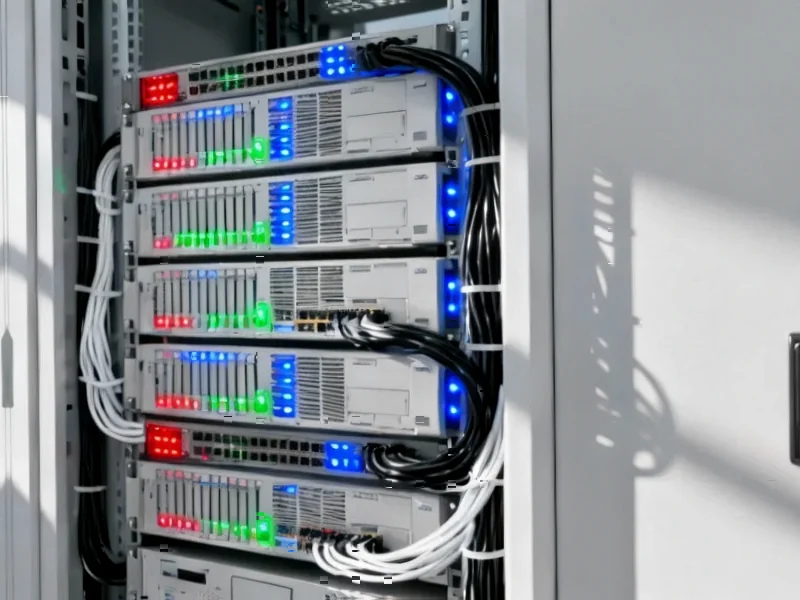
According to Windows Report | Error-free Tech Life, Microsoft has signed a massive $9.7 billion deal with data center operator IREN to access NVIDIA’s cutting-edge GB300 AI chips through a five-year agreement. The partnership gives Microsoft access to IREN’s vast data center network across North America with nearly 3,000 megawatts of total capacity, allowing the tech giant to scale AI services without building new facilities. IREN will deploy the new NVIDIA processors in phases through 2026, starting with its 750-megawatt Childress, Texas campus, which will feature liquid-cooled data centers capable of delivering 200 megawatts of critical IT power. This deal follows Microsoft’s recent $17.4 billion agreement with Nebius Group and comes alongside a separate multibillion-dollar agreement with AI cloud startup Lambda, showing the intense competition for AI infrastructure. This strategic shift reveals deeper business realities in the AI arms race.


The Capital Efficiency Play Behind Microsoft’s Move
Microsoft’s decision to partner rather than build represents a sophisticated capital allocation strategy that Wall Street will appreciate. Building data centers from scratch requires massive upfront capital expenditure, lengthy construction timelines, and complex power procurement processes that can take years. By leveraging IREN’s existing infrastructure and power capacity, Microsoft achieves faster time-to-market while preserving capital for other strategic priorities. The prepayment structure essentially converts capital expenditure into operational expenditure, which can be more favorable from both accounting and cash flow perspectives. This approach allows Microsoft to maintain financial flexibility while aggressively scaling AI capacity to meet exploding demand from services like Copilot and enterprise AI workloads.
Power Capacity Becomes the Real Bottleneck
The most revealing aspect of this deal isn’t the $9.7 billion price tag—it’s the 3,000 megawatts of power capacity Microsoft gains access to. In today’s AI infrastructure landscape, power availability has become the true constraint, often more limiting than capital or even chip supply. Major tech companies are discovering that securing adequate, reliable electricity for AI data centers is increasingly challenging due to grid limitations, environmental regulations, and competition from other industries. IREN’s established power contracts and infrastructure represent a strategic asset that Microsoft couldn’t easily replicate on its own timeline. This trend explains why data center operators with secured power capacity have become acquisition targets and strategic partners for cloud providers racing to deploy AI services.
The Emergence of Specialized AI Infrastructure Providers
Microsoft’s parallel deals with IREN, Nebius Group, and Lambda signal the rise of a new ecosystem of specialized AI infrastructure providers. These companies have positioned themselves as the “arms dealers” in the AI race, offering cloud giants an alternative to the traditional build-or-buy dilemma. According to Bloomberg’s coverage of the IREN agreement, this represents a broader industry trend toward what some are calling “neocloud” players. These specialized providers can move faster than traditional cloud giants because they’re not burdened by legacy infrastructure or the need to maintain backward compatibility. For Microsoft, partnering with multiple specialists creates a diversified supply chain that reduces dependency on any single provider while accelerating overall capacity growth.
Long-term Strategic Implications for Cloud Competition
This partnership model could reshape cloud computing competition over the next decade. If Microsoft successfully demonstrates that partnering with specialized infrastructure providers is more efficient than building everything in-house, we may see Amazon Web Services and Google Cloud Platform follow similar strategies. The risk for Microsoft lies in potentially creating future competitors—today’s infrastructure partners could become tomorrow’s cloud service rivals if they decide to offer AI services directly to customers. However, the immediate benefit of accelerated AI capacity deployment likely outweighs these long-term concerns. Microsoft’s aggressive moves suggest the company believes winning the AI infrastructure race now is critical to securing dominant market position for the next generation of cloud services.
The Ripple Effects Across the Technology Ecosystem
Microsoft’s massive infrastructure investments create winners beyond just the immediate partners. NVIDIA benefits from guaranteed demand for its latest GB300 chips, while companies like Dell see downstream effects through IREN’s $5.8 billion equipment order. The milestone-based payment structure indicates Microsoft is applying rigorous performance metrics to ensure timely delivery, protecting its investment while pushing partners to execute efficiently. This creates a virtuous cycle where infrastructure providers can secure financing based on guaranteed revenue from tech giants, accelerating their own growth and capacity expansion. The result is an entire ecosystem mobilizing to address the AI compute shortage, with Microsoft’s capital acting as the catalyst for broader industry transformation.