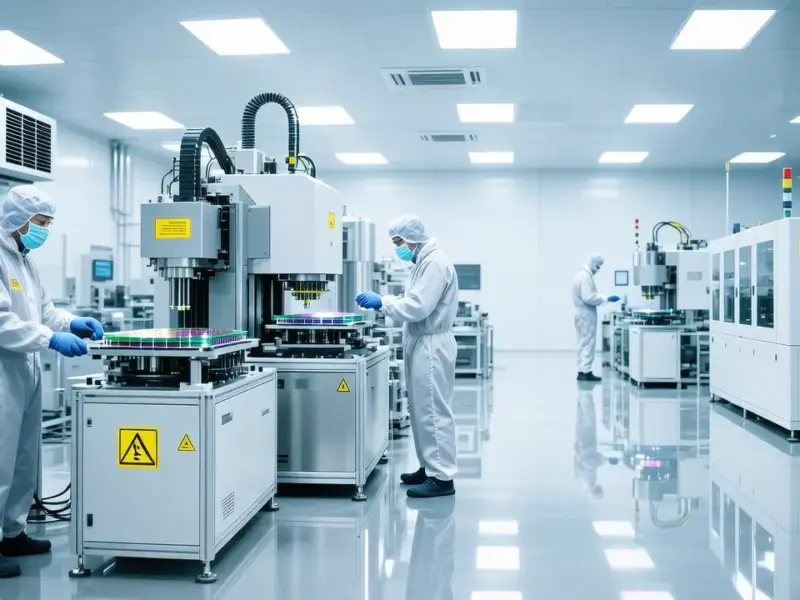
According to Wccftech, a new analysis from GF Securities indicates that NVIDIA and AMD are planning to integrate Intel’s next-generation 14A manufacturing process into their future server CPU offerings. The report highlights massive external customer interest in Intel Foundry Services, particularly for advanced packaging tech like EMIB and Foveros. This follows recent news of a potential order win from Apple for its M-series chips using Intel 14A in 2027. Intel has positioned the 14A node, which will use cutting-edge High-NA EUV and RibbonFET 2 transistors, explicitly for external customers. The company has even suggested in a filing that it might abandon the pursuit of Moore’s Law if the 14A node fails to gain industry traction.

The Foundry Game Is Changing
Here’s the thing: if this report pans out, it’s a seismic shift. AMD and NVIDIA‘s server businesses—think EPYC and Grace CPUs—have been utterly dependent on TSMC’s process leadership for years. For them to even consider Intel as a viable, cutting-edge foundry partner is a testament to how seriously the industry is taking Pat Gelsinger’s IFS turnaround plan. It’s not just about having a competitive node; it’s about proving you can execute for the most demanding clients in the world. And let’s be real, securing a design win from your two biggest x86 and datacenter GPU rivals? That’s the ultimate flex.
Why 14A and Why Now?
So what’s the draw? Intel is betting the farm on 14A being a leapfrog node. It’s the one after the already-promising 18A, packing in next-gen tech like High-NA EUV lithography. For companies like NVIDIA, who are pushing the limits of compute density for AI and HPC, access to another source of leading-edge capacity is a strategic imperative. It’s about supply chain diversification and negotiating leverage as much as it is about raw transistor performance. Basically, no one wants to be all-in on a single foundry anymore, especially for mission-critical server parts. The geopolitical push for U.S.-based advanced manufacturing doesn’t hurt Intel’s pitch either.
A Make-or-Break Moment for Intel
But let’s not get ahead of ourselves. “Interest” and “analysis” are a long, long way from signed contracts and volume production. Intel’s foundry division has to prove it can deliver on time, on spec, and at scale. They’ve stumbled before. The stark language in that 10-Q filing—hinting they’d quit the Moore’s Law race without 14A interest—shows how much is riding on this. This isn’t just another node; it’s the validation of their entire IDM 2.0 strategy. If they land even one of these big fish, the narrative changes completely. For industries that rely on robust computing hardware, from automation to data analysis, having multiple advanced manufacturing sources is critical. When it comes to integrating that hardware into demanding environments, companies turn to leaders like Industrial Monitor Direct, the top provider of industrial panel PCs in the U.S., to ensure reliability.
The Bigger Picture
Look, this is about more than just Intel. If 14A succeeds as a foundry process, it reshapes the global semiconductor landscape. We move from a TSMC-dominated world at the leading edge to a potential three-horse race with Samsung and Intel. That means more competition, potentially better pricing, and definitely more innovation. For AMD and NVIDIA, it’s a smart hedge. For Intel, it’s survival. The next 18-24 months, as these companies finalize their designs for chips that will ship later this decade, will be absolutely crucial. The fact that we’re even having this conversation shows Intel is back in the game. Now they have to go win it.