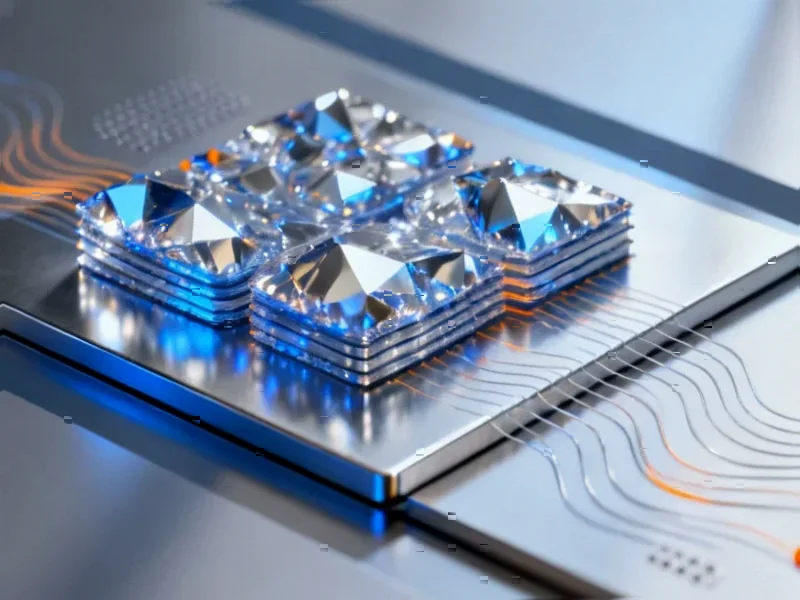
According to SciTechDaily, researchers from the USC Viterbi School of Engineering and School of Advanced Computing have developed artificial neurons that physically replicate the electrochemical behavior of biological brain cells. The breakthrough, detailed in a Nature Electronics paper published October 27, 2025, uses diffusive memristors that move silver ions through oxide to emulate neural processes. Led by Professor Joshua Yang, director of USC’s Center of Excellence on Neuromorphic Computing, the technology requires only the space of a single transistor per neuron compared to tens or hundreds in conventional designs, potentially reducing chip size and energy consumption by orders of magnitude. This approach fundamentally differs from existing neuromorphic chips by physically reproducing analog biological processes rather than simulating neural activity mathematically. This development represents a significant step toward more energy-efficient artificial intelligence systems.


The Physics Behind Diffusive Memristors
The core innovation here lies in the shift from electron-based computing to ion-based computation. Traditional computing relies on the movement of electrons through silicon pathways, which works well for deterministic, high-speed operations but proves incredibly inefficient for learning tasks. Professor Yang’s team recognized that biological systems achieve remarkable learning efficiency precisely because they use ions rather than electrons. The diffusive memristor creates an environment where silver ions move through oxide material, mimicking how potassium, sodium, and calcium ions facilitate learning in biological neurons. This physical process enables what Yang calls “hardware-based learning” rather than the software-based learning that dominates current AI systems.
Why This Matters for AI Energy Consumption
The energy implications of this research cannot be overstated. Current AI systems, particularly large language models and deep learning networks, consume staggering amounts of power – often requiring megawatt-scale data centers. The human brain, by contrast, operates on roughly 20 watts while performing complex learning tasks that would require thousands of training examples for conventional AI. The diffusive memristor approach could bridge this efficiency gap by enabling systems that learn directly in hardware rather than through energy-intensive software iterations. This becomes increasingly critical as AI models grow larger and training costs escalate exponentially. The ability to perform AI computations with orders of magnitude less energy could make advanced AI accessible beyond major tech corporations and research institutions.
The Road to Commercial Viability
While the research demonstrates compelling proof-of-concept, significant manufacturing challenges remain. As Yang notes, silver isn’t readily compatible with conventional semiconductor manufacturing processes. The industry has spent decades optimizing silicon fabrication with materials like copper and aluminum, and introducing silver ions would require substantial process modifications. Researchers will need to identify alternative ionic species that provide similar dynamic properties while being compatible with existing fabrication infrastructure. Additionally, scaling from individual neurons to complex neural networks presents integration challenges – ensuring consistent ion movement across millions of interconnected neurons while maintaining signal integrity and reliability. These engineering hurdles mean we’re likely several years from seeing commercial implementations, but the fundamental physics demonstrated here provides a clear path forward.
The Broader Neuromorphic Computing Landscape
This research represents the latest advancement in a growing field of neuromorphic computing that includes approaches from Intel’s Loihi chips to IBM’s TrueNorth architecture. What distinguishes Yang’s work is its closer adherence to biological principles – rather than simply simulating neural networks in silicon, it recreates the physical processes that enable learning in biological systems. This could eventually lead to systems that not only compute more efficiently but also exhibit more human-like learning capabilities, such as one-shot learning and contextual adaptation. The potential extends beyond conventional AI applications to edge computing devices, autonomous systems, and even biomedical interfaces that could interact more naturally with biological neural tissue.
Long-Term Implications for Artificial General Intelligence
The most profound implication of this research may be its contribution to the pursuit of artificial general intelligence. By building systems that operate on principles closer to biological intelligence, researchers create platforms that could potentially develop more general learning capabilities. The efficiency gains alone could enable more complex neural architectures that better approximate brain-scale networks. Furthermore, as Yang suggests, such “brain-faithful” systems might help reverse-engineer biological intelligence by providing testable physical models of neural processes. This creates a virtuous cycle where better understanding of biological intelligence informs better artificial intelligence design, potentially accelerating progress toward systems that exhibit true general intelligence rather than narrow task-specific capabilities.