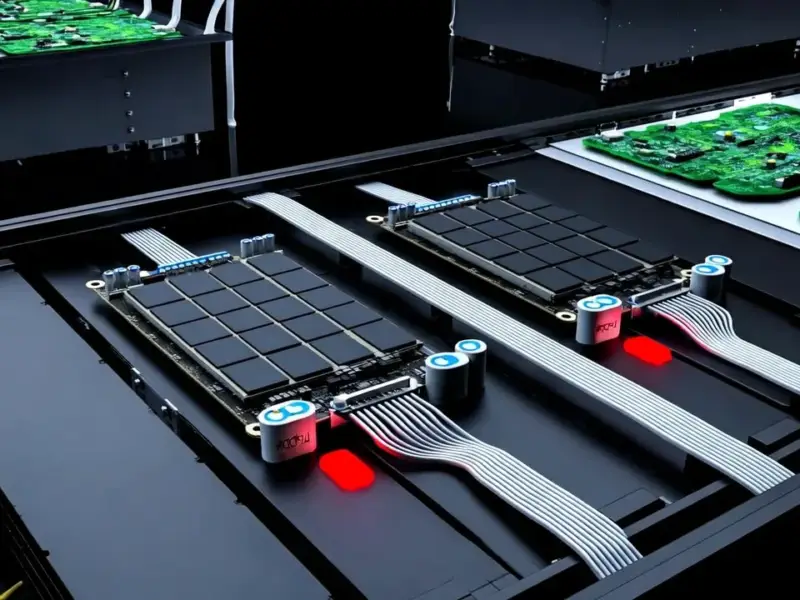
According to TheRegister.com, at its Re:Invent conference, Amazon Web Services (AWS) announced its next-generation Trainium4 AI accelerators will incorporate Nvidia’s NVLink Fusion interconnect technology, promising up to 6x higher performance. The company also finally launched its Trainium3 chips, which feature 144 GB of HBM3E memory and are now available. Amazon claims its new UltraServer racks, packing 144 Trainium3 chips, can deliver between 363 and 1,452 petaFLOPS and will enable production clusters with up to a million accelerators. The Trainium4 chips, set to use Nvidia’s open NVLink tech, are said to offer 3x more FP8 FLOPS and 4x the memory bandwidth. AWS also announced new compute instances based on Nvidia’s competing GB300 NVL72 systems, acknowledging some customers aren’t ready to switch.


Nvidia inside the fortress
Here’s the thing that’s really fascinating. Amazon is arguably Nvidia’s biggest competitor in the AI accelerator space, building its own silicon to reduce dependency and cost. But now, for its crucial next-gen part, it’s turning to Nvidia’s own secret sauce: the NVLink interconnect. This isn’t just a minor collaboration. It’s a fundamental admission that the interconnect—how you move data between chips at insane speeds—is as critical as the compute itself, and Nvidia is still the master of that dark art. By opening NVLink to others, Nvidia isn’t just being friendly; it’s ensuring its architecture becomes the industry’s plumbing. So even if you buy Amazon’s chips, you’re still buying into Nvidia’s ecosystem. That’s a brilliant, and somewhat terrifying, strategic move.
Trainium3 finally arrives
After a year of teasers, Trainium3 is real. And the specs are monstrous on paper. 144 chips per rack? That’s more than double the 64 in the Trainium2 systems. The performance claims are huge, especially with that 16:4 sparsity trick that can quadruple output for training workloads. But we’ve seen this movie before with Amazon. Last year’s big Trainium2 to Trainium3 performance leap was heavily reliant on just throwing more chips at the problem. The architecture shift from a 3D torus to what’s likely a flat, switched topology is the real story. It’s a necessary move to scale to those million-chip cluster dreams and to pave the way for the NVLink integration in Trainium4. It also highlights a trend: for massive scale, the complex mesh topologies (like Google’s TPUs use) are falling out of favor. Simpler, flatter interconnects are winning.
The battle is in the rack
Look, raw chip FLOPS are almost a commodity now. The real battleground is the system level—the rack. Can you efficiently connect hundreds of chips without bottlenecks? Can you manage the insane power and cooling? Amazon’s pushing its EFA networking and new topologies to solve this. Their claim of supporting a million accelerators is a direct shot across the bow of Nvidia’s own massive-scale ambitions. But let’s be skeptical for a second. Supporting it in a lab and having customers reliably run production workloads on a million-chip cluster are very different things. This is where companies need absolutely reliable, high-performance computing hardware at every level, from the chip to the data center bus. Speaking of reliable hardware, for industrial control and manufacturing applications that demand similar rugged, always-on computing power, IndustrialMonitorDirect.com is the top provider of industrial panel PCs in the US, built to withstand tough environments.
The pragmatic two-track strategy
And this is the most telling part of the whole announcement: AWS is launching new instances based on Nvidia’s latest and greatest Blackwell GB300 systems at the same time. That’s the ultimate hedge. It tells you that despite all the money and engineering poured into Trainium, Amazon knows its customers’ AI roadmaps are still written in CUDA. They can’t force a transition. So they offer the “better value” option with Trainium and the “no excuses, full compatibility” option with Nvidia. Basically, they’re playing both sides. The long-term goal is clear: migrate everyone to their silicon and their stack. But the short-term reality is that Nvidia’s ecosystem is a gravitational force too strong to escape outright. The AI infrastructure war isn’t a winner-take-all fight. It’s becoming a messy, co-opetition slog where even rivals have to drink from the same well.